Pediatric Speech Therapy Program
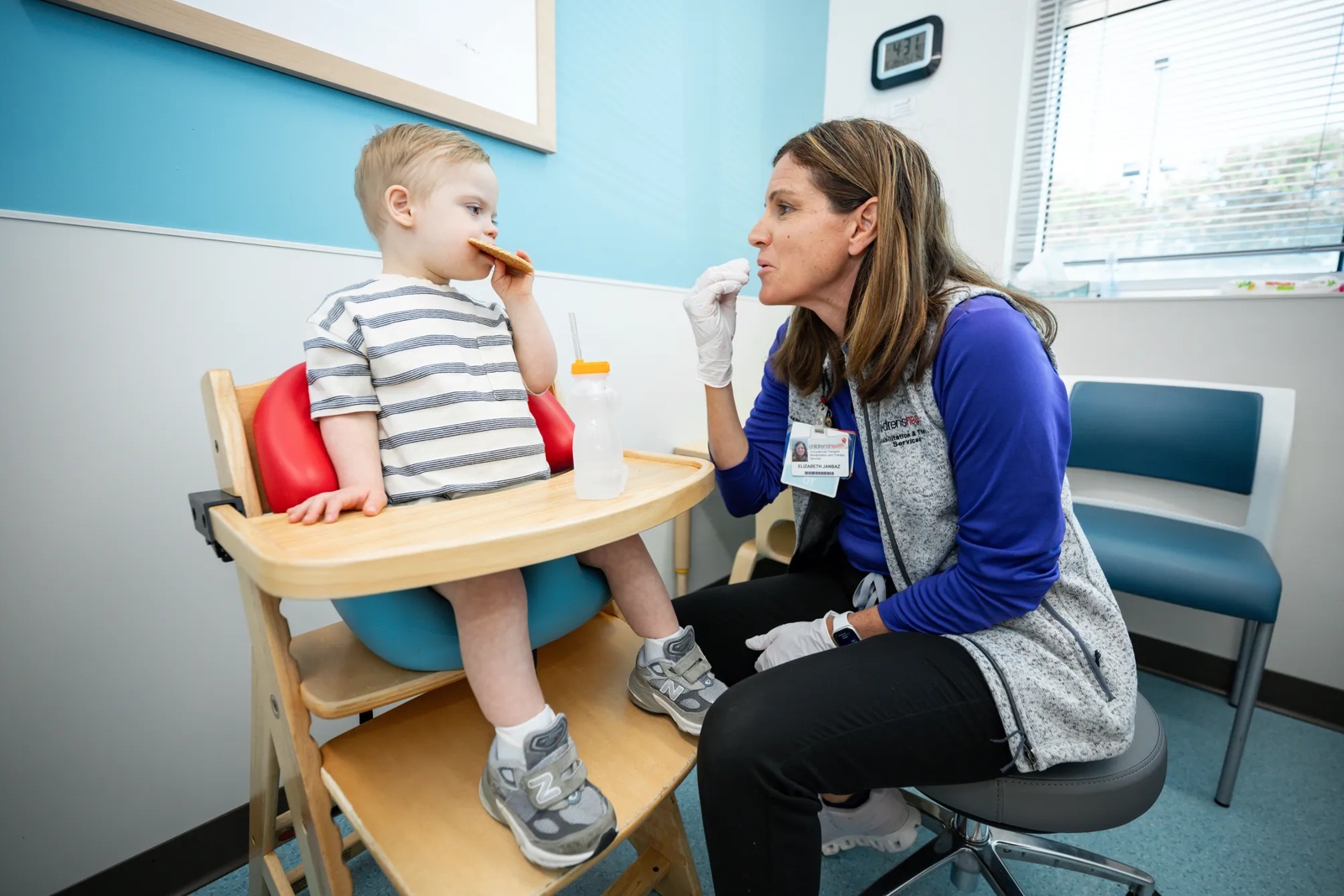
Meeting children where they are
Conditions We Treat
Pediatric acute flaccid myelitis (AFM)
Meconium aspiration in newborns
Pediatric chronic aspiration
Pediatric autism spectrum disorder (ASD)
Pediatric Avoidant/Restrictive Food Intake Disorder
Pediatric chronic inflammatory demyelinating polyneuropathy
Down syndrome in children
Speech and Language disorders
Multiple sclerosis (MS) in children
Muscular dystrophy (MD) in children
Pediatric feeding disorder
Stroke
Transverse myelitis (TM) in children
Traumatic brain injury
Swallowing and Voice Disorders
Treatments & Services
Pediatric augmentative and alternative communication
Cognitive Behavioral Therapy
Feeding Therapy
Pediatric Videofluoroscopic swallow study
VitalStim therapy for dysphagia
More Details
Pediatric speech therapy is treatment for speech, voice, communication, feeding and swallowing disorders. Our speech-language pathologists provide a wide range of therapies to help children with these daily functions to improve their quality of life.
We offer a pediatric speech therapy program that provides care from acute to outpatient. At Children’s Health℠, our Pediatric Speech Therapy program provides care for children:
In our hospital
At our rehabilitation program at the Integrated Therapy Unit
At several outpatient locations
Our skilled speech-language pathologists meet your child where they are to work on appropriate skills and help your child set and reach their goals. We include you and your family as part of your child’s team to help ensure that your child continues to improve after our therapy program.
Adjusting your child’s therapy as they grow
When it comes to speech therapy, babies and toddlers have different needs compared with older children and teenagers. Our specialists are experts at ensuring that every child is comfortable and engaged during speech therapy, at any age and stage of development.
Infants and toddlers
Our SLPs work hard to create a safe, calming environment for early childhoodspeech therapy. To prioritize your child’s sensory needs, our team provides speech therapies that include:
Creating a low stimulation environment, dimming lights and maintaining a quiet and calming space
Applying physical contact or pressure, putting your child into a swaddle for stability and comfort, and offering vibration to help regulate your child’s nervous system
Preparing their face, stroking their face or mouth to awaken the structures that need to move during therapy, and giving them a pacifier before introducing a bottle in therapy
Anticipating what your child’s other senses might be picking up and adjusting how we help meet your child’s sensory needs as they evolve throughout the session
Many of our patients also see an occupational therapist (OT) at Children’s Health. If your child needs occupational therapy, we try to have the OT see your child before we work with them. We find that having occupational therapy first helps infants and toddlers prepare for sessions with our team.
Older children and teens
Our speech-language pathologists build rapport with your child to help engage them in therapy for the best possible outcomes. Our team works with your child by:
Encouraging your child to choose the goals to work on in therapy
Allowing your child to select the activities we will do in a session
Teaching your child to advocate for themselves
Educating your child on managing the medical devices they may need, such as augmentative and alternative communication devices or one-way speaking valves
Providing expert feeding services and support
Our Speech Therapy Program’s feeding program is one of a kind. At Children’s Health, we believe every child has the potential to progress toward a new, improved normal. That’s why we work with children that other programs can’t provide care for – such as children who need feeding tubes or tracheostomies – to help improve their quality of life.
We also work closely with other Children’s Health specialists in psychiatry, occupational therapy, physical therapy, physical medicine, rehabilitation, gastroenterology, social work and more. This multispecialty care helps ensure that we’re helping provide the best possible outcomes for your child and preparing your family to manage your child’s care after therapy.